
No. AIRF/82
Dated: 23.06.2026
To
The Additional Member (HR),
Railway Board,
Rail Bhawan,
New Delhi.
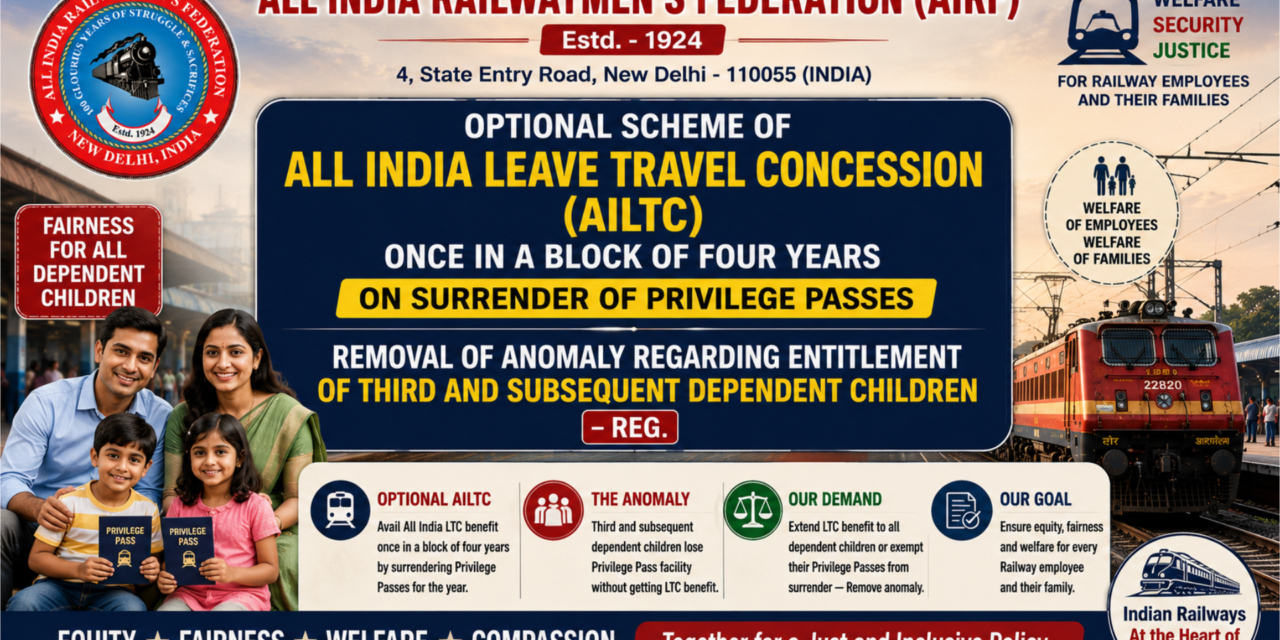
Sub: – Optional Scheme of All India Leave Travel Concession (AILTC) once in a Block of Four Years on Surrender of Privilege Passes – Removal of anomaly regarding entitlement of third and subsequent dependent children – Reg.
Ref: – Railway Board’s letter No. E(W)2017/PS5-1/3 dated 10.09.2018 (RBE No.130/2018).
- AIRF’s letters No. AIRF/82 dated 02.01.2026 and 23.05.2026.
- Railway Board’s letter No. 2026/E(W)/30/04/1 dated 20.05.2026.
- Railway Board’s letter No. 2026/E(W)/30/04/1 dated 17.06.2026.
Dear Sir,
The All India Railwaymen’s Federation (AIRF) once again seeks the kind intervention of the Railway Board in addressing a genuine and long-pending anomaly arising out of the implementation of the Optional Scheme of All India Leave Travel Concession (AILTC) introduced vide Railway Board’s letter dated 10.09.2018 (RBE No.130/2018).
The issue pertains to the treatment of third and subsequent dependent children of Railway employees under the said scheme and the consequent denial of a legitimate travel benefit despite compulsory surrender of Privilege Passes admissible to them under the Railway Pass Rules.
The Optional AILTC Scheme was introduced to extend the benefit of All India LTC to Railway employees once in a block of four years, subject to surrender of the Privilege Passes admissible for the relevant calendar year and in accordance with the provisions of the CCS (LTC) Rules, 1988.
The scheme, inter alia, provides that:
(i) Railway employees opting for AILTC are required to surrender the Privilege Passes admissible for the relevant year; and
(ii) The definition of “family”, eligibility of dependents and other conditions prescribed under the CCS (LTC) Rules, 1988 shall govern the admissibility of LTC.
Under the CCS (LTC) Rules, the term “family” generally includes the spouse and two surviving unmarried dependent children, subject to certain exceptions specifically provided under the Rules.
AIRF had earlier represented that a serious anomaly exists because the Railway Pass Rules and CCS (LTC) Rules recognize family members differently.
Under the Railway Pass Rules, all eligible dependent children of a Railway employee are entitled to Privilege Pass facilities irrespective of their number, whereas under the CCS (LTC) Rules, LTC is ordinarily restricted to two surviving children.
As a result, when a Railway employee opts for the AILTC Scheme, he/she is required to surrender the Privilege Passes admissible to all dependent children, including the third and subsequent children, but LTC reimbursement is allowed only for the beneficiaries covered under the CCS (LTC) Rules.
Consequently, the third and subsequent dependent children lose the Privilege Pass facility without becoming eligible for LTC benefits. This creates a situation where a section of family members suffers a complete deprivation of travel entitlement solely because the employee opted for AILTC.
Such an outcome is neither equitable nor consistent with the welfare-oriented objectives of the scheme. Rather, it places Railway employees having more than two dependent children at a clear disadvantage vis-à-vis other employees and effectively compels them to surrender an existing benefit without any corresponding compensatory facility.
Vide Railway Board’s letter dated 20.05.2026, AIRF was informed that the proposal could not be agreed to on the grounds that:
(a) DoP&T is the nodal authority for matters relating to CCS (LTC) Rules, 1988; and
(b) Acceptance of the proposal may amount to deviation from the mutually agreed terms and conditions governing extension of LTC facilities to Railway employees and may also involve financial implications.
Subsequently, AIRF requested a copy of the relevant terms and conditions referred to in the Board’s communication. The same was furnished vide Railway Board’s letter dated 17.06.2026.
A careful examination of DoP&T’s O.M. No. 31011/15/2017-Estt.A-IV dated 27.03.2018 reveals that while the definition of beneficiaries and family members under CCS (LTC) Rules is applicable for availing the All India LTC facility, the Office Memorandum does not address the unique position of Railway employees who are otherwise entitled to a distinct and long-established Privilege Pass system under the Railway Pass Rules.
It is respectfully submitted that Railway employees constitute a unique category of Government servants. Unlike other Central Government employees, Railway employees are entitled to Privilege Passes and PTO facilities during service as well as after retirement, in recognition of the peculiar nature of railway service and long-standing service conditions.
The Railway Pass Rules define family and dependent relatives much more comprehensively and cover categories of beneficiaries who are not recognized under the CCS (LTC) Rules. These provisions have been in existence for decades and form an integral component of the service conditions and welfare measures available to Railway employees.
Therefore, the direct application of the CCS (LTC) definition without accommodating the peculiarities of the Railway Pass Rules has unintentionally resulted in denial of benefits to a section of eligible dependents.
AIRF firmly believes that no employee should be placed in a position where an existing admissible benefit is surrendered without receiving an equivalent alternative benefit.
The present arrangement creates an unintended discrimination against employees having more than two dependent children and defeats the very purpose of introducing an optional welfare-oriented travel concession scheme.
The anomaly is not merely procedural in nature but has direct welfare and financial implications for affected Railway employees and their families. The issue, therefore, warrants sympathetic reconsideration and a pragmatic policy solution.
In order to remove the anomaly and protect the legitimate interests of Railway employees, AIRF earnestly requests the Railway Board to consider adoption of any one of the following alternatives:
(a) The benefit of Optional AILTC may be extended to all dependent children who are otherwise recognized as eligible family members under the Railway Pass Rules, including third and subsequent dependent children.
OR
(b) The Privilege Passes admissible to third and subsequent dependent children may be exempted from surrender while opting for AILTC. Accordingly, such eligible dependent children may continue to avail Privilege Pass facilities even when the employee opts for the LTC Scheme.
AND/OR
(c) A suitable reference may be made to the Department of Personnel & Training (DoP&T) seeking necessary amendment/clarification in O.M. No. 31011/15/2017-Estt.A-IV dated 27.03.2018 so as to recognize the definition of “family” and “dependents” as contained in the Railway Pass Rules for the purpose of the Optional AILTC Scheme applicable to Railway employees.
AIRF strongly reiterates that the existing anomaly can be effectively resolved by ensuring that dependent children who are entitled to Privilege Passes under the Railway Pass Rules are not deprived of their travel entitlement merely because the employee opts for the Optional AILTC Scheme.
The Federation, therefore, urges the Railway Board to take up the matter with utmost priority and evolve a suitable mechanism whereby either the LTC benefit is extended to such children or their Privilege Pass entitlement is protected from compulsory surrender.
Such a decision would not only remove a long-standing anomaly but would also uphold the principles of equity, fairness and employee welfare that have always guided Railway administration.
AIRF, therefore, requests the Railway Board to reconsider the matter sympathetically and favourably and issue suitable instructions at the earliest to safeguard the legitimate interests of Railway employees and their families.
An early, positive and compassionate decision in the matter shall be highly appreciated.
Yours faithfully,
(Shiva Gopal Mishra)
General Secretary
Copy to:
General Secretary, All affiliated Unions of AIRF – For information.