
No. AIRF/53 Dated: 01.08.2026
The Director General (HR),
Railway Board,
Rail Bhawan,
New Delhi.
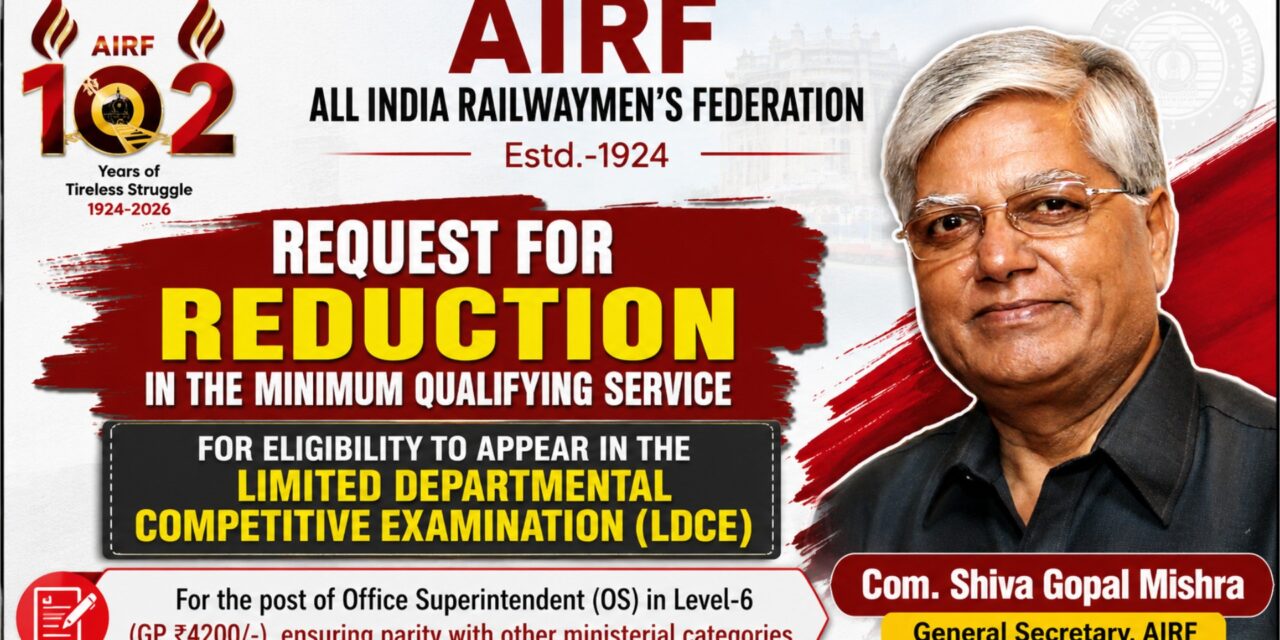
Sub:– Request for reduction in the minimum qualifying service for eligibility to appear in the Limited Departmental Competitive Examination (LDCE) for the post of Office Superintendent (OS) in Level-6 (GP ₹4200/-), ensuring parity with other ministerial categories.
Ref:
- Railway Board’s letter No. E(NG)I/2016/PM 1/14 dated 01.03.2019 (RBE No. 38/2019)
- Railway Board’s RBE Nos. 102/2005, 147/2006, 34/2007, 130/2012 and 78/2019
- AIRF’s letter No. AIRF/53 dated 29.05.2026 and 19.06.2026.
- Railway Board’s letter No. E(NG)I-2026/PM4/7 (E-3535492) dated 30.07.2026.
Dear Sir,
Kindly refer to AIRF’s letters cited above, wherein the Federation had requested for reduction of the minimum qualifying service prescribed for Senior Clerks for appearing in the Limited Departmental Competitive Examination (LDCE) for the post of Office Superintendent (OS) in Level-6 (GP ₹4200/-), from the existing 03 years to 02 years.
AIRF has carefully gone through the reply furnished by the Railway Board vide its letter dated 30.07.2026. The Federation appreciates the observations made by the Board; however, it is regretted that the genuine and long-pending demand has not been considered in its proper perspective. The grounds advanced by the Board, in our considered view, do not adequately justify continuation of the three-year residency period, particularly when the demand is only to make an employee eligible to appear in a competitive LDCE and does not confer any automatic right to promotion.
The Federation would, therefore, request that the matter may kindly be reconsidered in the light of the following:
1. Eligibility to appear in LDCE is not equivalent to automatic promotion:
The Federation fully appreciates that the post of Office Superintendent is supervisory in nature and that adequate experience is necessary for discharging supervisory responsibilities. However, reducing the qualifying service from three years to two years would not result in automatic induction of an inexperienced employee into the supervisory post.
The proposed reduction would merely enable a Senior Clerk, after completion of two years of regular service, to participate in the competitive LDCE. The employee would still be required to qualify the prescribed examination and fulfil all other conditions laid down under the relevant rules.
Thus, the competitive examination itself provides an effective mechanism for assessing the candidate’s knowledge, aptitude, suitability and competence before appointment to the supervisory post. Hence, the apprehension that reduction of one year in the residency period would compromise the quality of supervisory staff does not appear to be fully justified.
2. Experience cannot be measured merely by length of service:
It is respectfully submitted that, in the present-day working environment, experience cannot be assessed solely on the basis of the number of years an employee has spent in a particular post.
The nature of ministerial work in Indian Railways has undergone a substantial transformation. The younger generation of Railway employees is generally well educated, professionally trained, computer literate and conversant with modern information technology, digital systems, e-Office, electronic communication, data management and other technology-enabled office procedures.
Many of the present-day Senior Clerks possess higher educational qualifications and updated knowledge and are fully capable of acquiring the requisite supervisory skills and shouldering the responsibilities of Office Superintendent.
Therefore, one additional year of residency by itself cannot reasonably be treated as the decisive measure of competence, particularly when the candidate is required to demonstrate his/her suitability through a competitive LDCE.
3. The demand is only for reduction from three years to two years:
AIRF has never sought abolition of the experience requirement. The demand is limited to reduction of the minimum qualifying service by only one year, i.e. from three years to two years.
An employee appearing in the LDCE after two years of regular service would already possess practical exposure to Railway working and, more importantly, would have to prove his/her competence through the competitive examination.
Thus, the proposed amendment would not amount to dilution of the standard of selection; rather, it would only enlarge the field of eligible candidates.
4. Competitive examination itself safeguards the quality of selection:
The very purpose of an LDCE is to identify the most suitable and meritorious candidates on the basis of competitive assessment.
If a candidate having two years of service does not possess adequate knowledge or aptitude, he/she would naturally not qualify the examination. Conversely, if an employee with two years of service possesses the requisite knowledge, competence and aptitude and successfully qualifies the LDCE, there appears to be little justification for denying such employee an opportunity to compete merely for want of one additional year of residency.
Thus, the proposal seeks equality of opportunity without lowering the standard of selection.
5. Comparison with Level-6 supervisory posts of other departments needs to be viewed in the proper perspective:
The Railway Board has stated that there is no disparity with Level-6 supervisory posts in other departments and has referred to an analysis indicating three years’ residency for such posts, including JEs, except in the Drawing cadre.
In this regard, AIRF respectfully submits that comparison merely on the basis of pay level and residency period does not present the complete picture. The ministerial cadre has its own distinct recruitment, promotional and career-progression structure, which cannot always be equated with technical/engineering cadres such as JEs.
The nature of duties, educational qualifications, recruitment channels, promotional avenues and examination mechanisms of ministerial and technical categories are different. Therefore, the fact that a three-year residency period exists in certain technical/supervisory cadres cannot, by itself, constitute sufficient justification for retaining the same condition in the ministerial cadre.
The relevant consideration should be whether a Senior Clerk with two years of regular service, coupled with the existing competitive LDCE mechanism, can reasonably acquire the requisite exposure and demonstrate competence for the post. AIRF firmly believes that the answer is in the affirmative. 6. Railway Board itself has reduced residency periods in several categories:
The Federation respectfully submits that, on several earlier occasions, the Railway Board has itself reduced the prescribed qualifying service/residency period in various categories wherever administrative necessity and career progression so warranted.
Illustratively, vide RBE No. 102/2005, the residency period in certain categories was reduced from three years to two years. Similarly, vide RBE No. 147/2006, RBE No. 34/2007, RBE No. 130/2012 and RBE No. 78/2019, suitable relaxations and rationalization of eligibility conditions were introduced for different categories in the interest of better promotional prospects and administrative efficiency.
These precedents clearly establish that residency periods are not immutable and can always be reviewed in deserving cases. The present proposal is, therefore, fully consistent with the Railway Board’s own policy approach adopted in earlier cases.
7. Better career progression improves efficiency and motivation:
One of the principal objectives of any service jurisprudence is to provide reasonable promotional opportunities so that employees remain motivated and committed to organisational goals.
The ministerial cadre has been repeatedly representing that the existing three-year condition unnecessarily delays career progression despite availability of a competitive examination.
Reducing the qualifying service by one year would improve promotional prospects, reduce frustration among deserving employees and encourage them to prepare for the LDCE at an earlier stage of service without adversely affecting administrative efficiency.
8. Administrative interest would also be served:
Availability of a larger pool of eligible candidates would improve competition and enable the Administration to select the best available talent through the LDCE.
This would also facilitate timely filling up of vacancies, reduce prolonged vacancy positions and strengthen supervisory administration.
Thus, the proposal would simultaneously benefit both the employees and the Administration.
9. Principle of equality of opportunity:
The Federation respectfully submits that the opportunity to compete for promotion through an LDCE constitutes an important facet of equality of opportunity in public employment.
Where an employee has acquired sufficient practical exposure after two years of regular service and is otherwise capable of qualifying a competitive examination, denial of an opportunity to compete merely because of one additional year of residency does not appear to advance any substantial public interest.
The proposed amendment would, therefore, enlarge equality of opportunity while maintaining merit-based selection through the existing examination system. 10. No adverse financial implications:
The proposed amendment would not involve any additional financial burden on the Railway Administration. It merely seeks reduction in the qualifying service prescribed for appearing in the LDCE. Promotions would continue to be made only against the existing sanctioned vacancies and strictly in accordance with the prescribed selection procedure.
Therefore, no additional posts, financial outgo or change in the existing promotional hierarchy would be involved.
11. Prayer:
In view of the foregoing facts and circumstances, the Federation most respectfully requests that the matter may kindly be reconsidered sympathetically.
The existing provision prescribing three years’ regular service for eligibility to appear in the Limited Departmental Competitive Examination (LDCE) for promotion to the post of Office Superintendent (OS) in Level-6 (GP ₹4200/-) may kindly be amended by reducing the qualifying service to two years, thereby ensuring a fair, rational and progressive promotional policy for the ministerial staff.
The Federation firmly believes that the proposed amendment would neither dilute the standard of selection nor compromise administrative efficiency. On the contrary, it would enlarge the field of competition, improve career progression, motivate deserving employees and ultimately strengthen the ministerial administration of the Indian Railways.
AIRF, therefore, once again requests your goodself to kindly reconsider the matter favourably and arrange to issue the necessary amendment to the existing instructions at an early date.
An early and favourable decision in the matter shall be highly appreciated.
Yours faithfully,
(Shiva Gopal Mishra)
General Secretary
Copy to:
General Secretaries, All Affiliated Unions – For information.